

American Bitcoin (ABTC), the mining company co-founded by Eric Trump and Donald Trump Jr., saw its stock collapse nearly 50% within the first hour of trading on 2 December. The price fell from $3.58 to $1.80 before recovering slightly to close at $2.19, still down 38.83%.
In after-hours trading on 3 December, the stock bounced roughly 11%, stabilizing around $2.43.
What caused the ABTC crash?
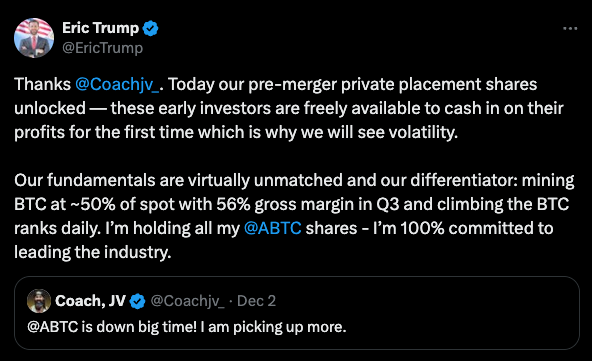
The selloff was triggered by the expiration of the company’s share lockup period, which released a large batch of previously restricted shares onto the open market.
These lockups were part of the company’s transition to a public listing after its merger with Gryphon Digital Mining. Once the restrictions lifted, a flood of supply hit the market, creating sharp downward pressure on the stock.
Eric Trump responds
Eric Trump addressed the event publicly, confirming that the volatility stemmed from private placement shares becoming tradable.
He emphasized that he is not selling any of his own shares and reiterated that the short-term shock was expected given the volume of newly unlocked stock.
ABTC Strong fundamentals contrast with stock volatility
Despite the steep decline, ABTC recently posted strong financial results.
In the third quarter, the company reported:
• Revenue of $64.2 million, up sharply from $11.6 million a year earlier
• Net income of $3.5 million, a turnaround from prior losses
The company is also expanding its Bitcoin treasury, holding roughly 4,090 BTC as of mid-November.
A volatile history on the Nasdaq
Since its public debut, American Bitcoin has shown extreme price swings.
Its shares surged to $9.31 in September following a $170 million investment from Dominari Holdings but then entered a prolonged decline.
Even before the lockup expiry, the stock had already lost momentum.
With the latest crash, ABTC now sits more than 75% below its yearly high.
Growing presence across the crypto sector
The Trump family has expanded its involvement across multiple corners of the digital asset industry.
Their ventures now include mining firms, token projects, stablecoins, and cryptocurrency-related financial products through entities like World Liberty Financial.