

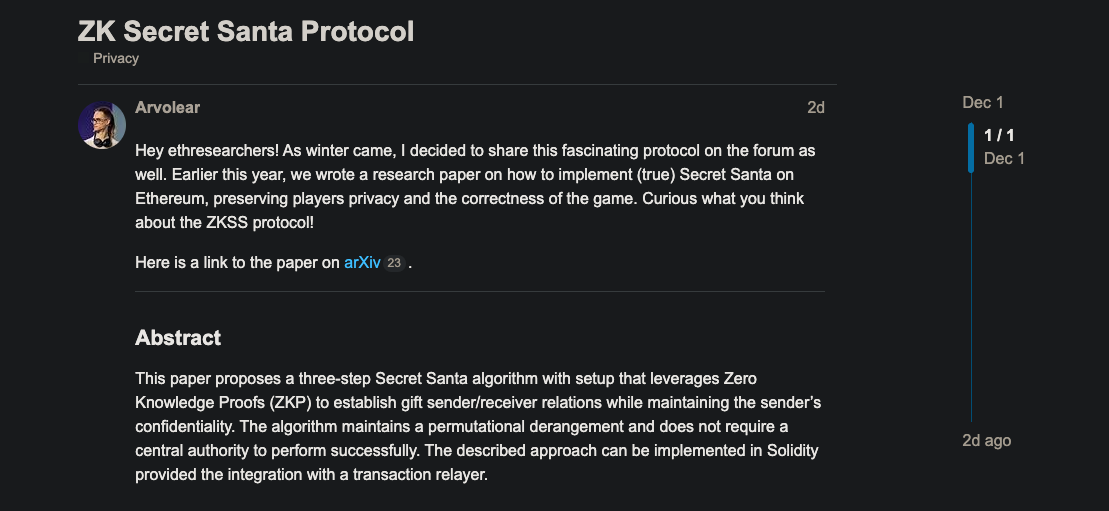
Privacy has become one of the strongest narratives of 2025, and as the year-end approaches, interest in privacy-focused tools continues to grow. In this environment, an Ethereum developer has introduced an experimental idea: a “Secret Santa” protocol designed to let users send gifts anonymously.
This comes as part of a wider push within the Ethereum ecosystem to expand privacy features on the network. Earlier in September, the Ethereum Foundation published a comprehensive privacy roadmap covering every layer of the stack, from wallet-level protections to fully private retail and institutional payments.
Already, progress is visible through frameworks like Kohaku, which is enabling private wallet operations.
What could Ethereum trajectory look like in 2026?
Ethereum’s development priorities for 2026 are moving across three major areas: privacy, scaling, and AI.
The network’s recent upgrades, including Pectra and Fusaka, have significantly improved throughput and reduced transaction costs. Fees have fallen to the point where Ethereum’s Layer 1 is beginning to rival some Layer 2 networks.
Vitalik Buterin recently highlighted that users can build directly on L1 again due to current low fees.
The ongoing L1 vs. L2 debate
Buterin’s comments sparked discussions within the community.
Blockworks analyst Dan Smith argued that L2 networks consume most of the blobspace and function much like direct competitors to L1 execution.
He compared the relationship to carpenters relying on a lumber yard: both operate in the same ecosystem without always competing directly.
Other analysts pushed back, noting that both L1 and L2 solutions still compete for builders and users.
Supporters of Buterin’s view, including Hasu, pointed out that distribution models naturally overlap, saying that a company can sell through its own channels while also using third-party platforms.
What remains clear is that L2 networks currently capture a large share of economic activity while contributing very little back to the mainnet.
For example, Base generated more than three million dollars in fees in the last 24 hours but paid only a few thousand dollars to Ethereum L1.
This imbalance is often cited as one reason why ETH’s value has struggled to keep pace with its network activity.
What comes next for Ethereum?
Whether upcoming privacy tools and scaling improvements can shift ETH’s tokenomics remains an open question.
As Ethereum moves toward 2026 with new privacy initiatives and ongoing debates around economic incentives, the network’s long-term direction will likely depend on how effectively it aligns its L1 and L2 ecosystems.