

XRP continued to attract capital even as its price remained range bound. Despite steady inflows and expanding infrastructure, the token traded near the $2 level, reflecting a growing disconnect between underlying activity and short-term market response.
This divergence placed XRP under close observation, as capital rotation and network developments advanced faster than price action.
XRP Price Compression Persists Despite Inflows
At the time of writing, XRP was trading near the 50 percent Fibonacci retracement level around $2.02. Volatility continued to tighten, forming an ascending triangle pattern that typically reflects consolidation rather than trend reversal.
Momentum indicators pointed to hesitation rather than weakness. The Relative Strength Index hovered near 42, suggesting neutral conditions, while the Moving Average Convergence Divergence indicator compressed and approached a potential bullish crossover.
Price action did not immediately reflect the increase in capital inflows, indicating absorption rather than distribution. Liquidity remained concentrated within the current trading range, suggesting that the market was testing patience instead of signaling loss of confidence.
Overall, technical signals remained consistent with consolidation, as momentum indicators did not confirm a breakdown. This structure implied that positioning may be building beneath the surface rather than exiting the market.
Capital Inflows Continue Without Immediate Price Reaction
XRP recorded approximately $16.42 million in net inflows, extending a streak that has now lasted 19 consecutive days. Despite this sustained demand, price movement remained limited.
The recent launch of 21Shares’ spot XRP exchange traded fund, listed under the ticker TOXR, expanded regulated market access. While this added to inflow activity, it did not result in immediate repricing.
Historically, XRP has experienced similar phases where capital inflows and access expansion precede price adjustments. In such cases, price reactions have often followed once positioning stabilizes.
XRP Infrastructure Expansion Adds Fundamental Weight
Beyond market data, Ripple continued to expand its infrastructure footprint. The company confirmed the completion of its Rail acquisition, strengthening its stablecoin and payments capabilities across its broader ecosystem.
Earlier expansions across custody services, treasury intelligence, and prime brokerage have positioned Ripple as a more comprehensive digital asset infrastructure provider. These efforts aim to support institutional use cases rather than short-term trading demand.
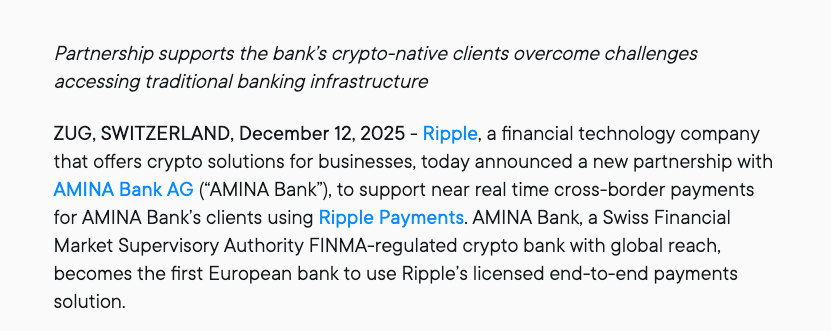
Ripple also announced the first European bank adoption of Ripple Payments through AMINA Bank. This integration extends real-time cross-border settlement into regulated markets, further broadening XRP’s utility.
These developments contributed to the widening gap between its growing operational role and its compressed price behavior.
XRP Market Focus Shifts to Timing
XRP’s current structure reflects a familiar pattern in which fundamentals and capital flows build ahead of price movement. As consolidation continues, attention has shifted from growth metrics to timing.
With inflows persisting and infrastructure expanding, the market appears to be in a holding phase. Whether this compression resolves through a price expansion or extended consolidation will depend on broader market conditions and sustained demand.